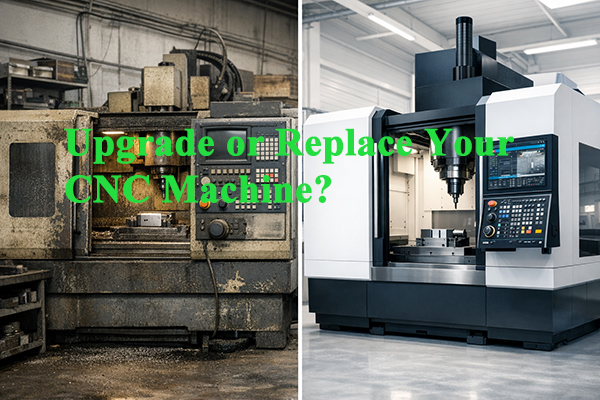
Votre centre d'usinage CNC ne fonctionne plus comme avant ?
Un usinage plus lent, une précision inconstante et des coûts de maintenance en hausse sont des signes courants indiquant qu'un changement est nécessaire.
Mais voici la vraie question :
Mettre à niveau votre machine actuelle ou la remplacer par une nouvelle ?
Ce guide vous aidera à comprendre rapidement les deux options et à choisir celle qui convient le mieux à votre production.
Avant de prendre une décision, il est important de comprendre ce qu'impliquent réellement les termes « mise à niveau » et « remplacement ».
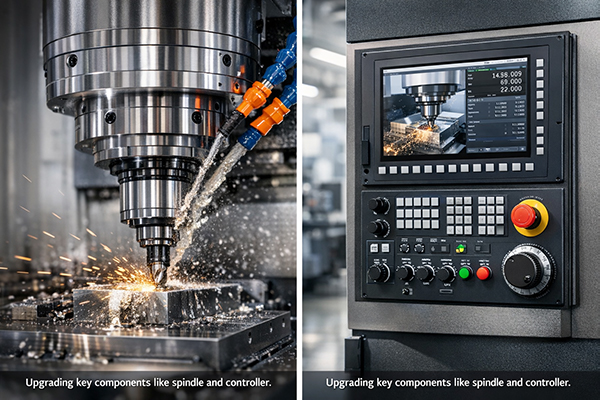
Mettre à niveau signifie améliorer votre système existant centre d'usinage CNC en remplaçant ou en ajoutant des composants clés, tels que la broche, le contrôleur ou le système servo.
Cela permet d'améliorer les performances et de prolonger la durée de vie de la machine, sans modifier sa structure globale.
Le remplacement implique d'investir dans un centre d'usinage CNC entièrement neuf, doté d'une nouvelle structure, d'un nouveau système et de nouvelles capacités.
Elle offre une mise à niveau complète des performances, incluant une précision accrue, une meilleure efficacité et la prise en charge de l'automatisation moderne.
Avec le temps, même un centre d'usinage CNC de haute qualité commencera à montrer des signes de déclin de performance.
L'essentiel est de savoir si ces problèmes peuvent être résolus par une mise à niveau, ou s'il est temps de procéder à un remplacement complet.
Voici les signes avant-coureurs les plus courants à surveiller :
Si votre machine ne parvient plus à respecter systématiquement les exigences de tolérance, c'est un signe d'alarme sérieux.
Vous remarquerez peut-être :
Écarts dimensionnels croissants
mauvaise finition de surface
Les taux de retouche ou de mise au rebut augmentent.
Problèmes mineurs de précision → peuvent être résolus par des mises à jour
Perte de précision persistante → nécessite probablement un remplacement
Des arrêts machine inattendus peuvent perturber l'ensemble de votre planning de production.
Les signes typiques comprennent :
Alarmes répétées ou erreurs système
Défaillances de composants (servo, broche, contrôleur)
Augmentation de la fréquence de maintenance
Si les temps d'arrêt deviennent réguliers, la machine n'est plus fiable et le temps de production perdu peut coûter plus cher qu'une machine neuve.
Si votre machine peine à suivre le rythme de la production, elle limite la croissance de votre entreprise.
Vous pourriez ressentir :
longs cycles d'usinage
Temps de changement d'outils lents
Une intervention manuelle est fréquemment nécessaire
Les problèmes d'efficacité peuvent parfois être améliorés par des mises à niveau, mais seulement dans une certaine mesure.
Les industries modernes exigent des géométries de plus en plus complexes et des tolérances plus strictes.
Si votre machine :
Ne peut pas gérer l'usinage multifaces
Absence de fonctionnalité sur les 4e et 5e axes
Difficultés avec les contours complexes
Il s'agit généralement d'une limitation de la structure de la machine et du système de commande ; le remplacement est souvent la meilleure solution.
Les machines plus anciennes ont tendance à devenir plus coûteuses à entretenir avec le temps.
Problèmes courants :
Les pièces détachées deviennent de plus en plus difficiles à trouver.
Des coûts de réparation plus élevés
Consommation d'énergie accrue
Lorsque les coûts de maintenance approchent la valeur de la machine, la mise à niveau n'est plus rentable.
Un système CNC obsolète peut limiter à la fois les performances et la facilité d'utilisation.
Vous remarquerez peut-être :
Traitement des données lent
Compatibilité limitée avec les logiciels modernes
Interface utilisateur médiocre
La mise à niveau des contrôleurs peut être utile, mais si le système est trop ancien, un remplacement complet est souvent plus pratique.
Une fois les problèmes de performance identifiés, la mise à niveau des composants clés peut constituer un moyen rentable d'améliorer votre centre d'usinage CNC, sans avoir à investir dans une machine entièrement neuve.
Voici les options de mise à niveau les plus courantes et les plus efficaces :
Le contrôleur est le « cerveau » de votre machine. Sa mise à niveau peut améliorer considérablement la vitesse de traitement et la réactivité globale de la machine.
Principaux avantages :
Traitement des données plus rapide et contrôle de mouvement plus fluide
Interface utilisateur améliorée et fonctionnement plus simple
Meilleure compatibilité avec les systèmes CAO/FAO
La broche influe directement sur la vitesse de coupe, la finition de surface et la capacité d'usinage.
Les options de mise à niveau comprennent :
Broche à grande vitesse (pour l'aluminium, pièces de précision)
Broche à couple élevé (pour acier, coupe intensive)
Principaux avantages :
Amélioration de l'efficacité d'usinage
meilleure qualité de surface
Capacités matérielles accrues
Les servomoteurs et les variateurs contrôlent la précision du positionnement et la stabilité du mouvement.
Principaux avantages :
Précision de positionnement accrue
Accélération et décélération plus rapides
Mouvement plus fluide et vibrations réduites
Un changeur d'outils automatique amélioré peut réduire considérablement le temps d'arrêt.
Principaux avantages :
Cycles de changement d'outils plus rapides
productivité accrue
Prise en charge des procédés d'usinage plus complexes
L'ajout d'automatisation peut transformer une machine ancienne en une unité de production plus efficace.
Les options comprennent :
Systèmes de changement de palettes
chargement/déchargement de robots
Surveillance automatique des outils
Principaux avantages :
Réduction des coûts de main-d'œuvre
Régularité accrue de la production
Capacité à fonctionner sans surveillance
Les logiciels modernes peuvent améliorer à la fois les performances et la visibilité.
Exemples :
Mises à jour logicielles CNC
systèmes de surveillance IoT
Outils de maintenance prédictive
Principaux avantages :
Surveillance de la production en temps réel
Temps d'arrêt réduit
Optimisation basée sur les données
Facteur | Mise à niveau de la machine existante | Remplacer par une machine neuve |
coût initial | Investissement initial réduit | Investissement initial plus élevé |
Amélioration des performances | Amélioration partielle | Amélioration globale significative |
Structure de la machine | Reste inchangé | Structure entièrement nouvelle et optimisée |
Précision et stabilité | Limité par l'usure existante | Haute précision et stabilité à long terme |
Efficacité de la production | Augmentation modérée | Forte augmentation |
Durée de vie de la machine | Prolongé (court à moyen terme) | Cycle de vie complet |
Capacité d'automatisation | Compatibilité limitée | Prend pleinement en charge l'automatisation moderne |
Temps d'arrêt pour la mise en œuvre | Plus court | Plus long (installation et configuration) |
À première vue, la mise à niveau de votre centre d'usinage CNC semble être le choix le plus économique.
Coût initial plus faible, temps d'arrêt réduit : c'est une victoire rapide et facile.
Mais la vraie question est :
Quelle option offre le meilleur retour sur investissement (ROI) au fil du temps ?
Mise à niveau (coût initial inférieur)
Investissement initial réduit
Mise en œuvre plus rapide
Amélioration immédiate dans des domaines spécifiques
Cependant:
Les gains de performance sont limités
Les coûts d'entretien se poursuivent souvent.
Des mises à jour supplémentaires pourraient être nécessaires ultérieurement.
Remplacement (investissement initial plus élevé)
Coût d'achat plus élevé
Installation et formation requises
Mais en contrepartie :
Amélioration significative des performances
Réduction des temps d'arrêt et de maintenance
une efficacité de production accrue
De nombreux fabricants se concentrent uniquement sur le coût initial, mais négligent les dépenses cachées :
Avec la mise à niveau :
Remplacement répété des composants
Augmentation des coûts d'entretien
Retards de production dus à l'instabilité des machines
Taux de rebut ou de retouche plus élevés
Ces coûts s'accumulent au fil du temps et réduisent la rentabilité globale.
Avec remplacement :
Investissement initial plus élevé
Interruption temporaire de la production pendant l'installation
Mais une fois opérationnel :
Production stable
taux d'échec plus faible
Qualité de production constante
Le principal facteur de retour sur investissement n'est pas le coût, mais la productivité.
Un nouveau centre d'usinage CNC peut fournir :
cycles d'usinage plus rapides
Temps d'inactivité réduit
Meilleure intégration de l'automatisation
Rendement plus élevé par poste
Prenons une comparaison simplifiée :
Machine améliorée :
Amélioration modérée de l'efficacité
coûts d'entretien courants
Capacité de production limitée
Nouvelle machine :
Augmentation significative de l'efficacité
Fonctionnement stable à long terme
production plus élevée
Avec le temps, la nouvelle machine s'autofinance souvent grâce à l'augmentation de la productivité et à la réduction des coûts d'exploitation.
Après avoir examiné les deux options, votre décision doit tenir compte de l'état de votre machine, de vos besoins de production et de vos objectifs à long terme. Les points suivants peuvent vous aider à faire un choix pratique et éclairé.
La première étape consiste à vérifier la solidité de votre machine. Si sa structure est stable et que la plupart des problèmes proviennent de composants individuels, une mise à niveau peut rétablir efficacement ses performances et prolonger sa durée de vie.
Toutefois, si la machine présente une usure structurelle, une rigidité insuffisante ou des problèmes de précision persistants, ces limitations ne peuvent être fondamentalement résolues par des mises à niveau, ce qui fait du remplacement la solution la plus fiable.
Vos besoins en usinage sont déterminants dans cette décision. Si votre production actuelle concerne des pièces relativement simples et une précision modérée, une machine plus performante pourrait tout à fait répondre à vos attentes.
Mais si vous vous orientez vers des géométries plus complexes, des tolérances plus strictes ou des exigences de productivité accrues, les machines plus anciennes deviennent souvent un frein. Dans ce cas, leur remplacement permet de mieux soutenir une production de pointe.
Bien que la mise à niveau nécessite un investissement initial moindre, elle peut engendrer des coûts de maintenance continus et des améliorations répétées au fil du temps. À l'inverse, une machine neuve représente un coût initial plus élevé, mais offre des performances plus stables, un taux de panne plus faible et une productivité accrue. Sur le long terme, le remplacement s'avère souvent plus avantageux.
Si votre entreprise est en pleine croissance, votre équipement doit pouvoir accompagner cette expansion. Une mise à niveau peut résoudre les problèmes actuels, mais n'offre pas toujours la flexibilité nécessaire pour les développements ou l'automatisation futurs. Un nouveau centre d'usinage CNC permet de mieux gérer une capacité de production accrue, une efficacité améliorée et une intégration optimale avec les systèmes de production modernes.
En général, la mise à niveau est appropriée lorsque la machine fonctionne encore correctement et ne nécessite que des améliorations ciblées. Le remplacement est préférable lorsque les limitations de performance, les problèmes de fiabilité ou les exigences de production futures dépassent les capacités de la machine actuelle.
Est-il judicieux de moderniser un ancien centre d'usinage CNC ?
La modernisation d'un ancien centre d'usinage CNC peut s'avérer judicieuse si la machine possède encore une structure robuste et si les problèmes sont principalement liés à des composants obsolètes tels que le contrôleur, la broche ou le système d'asservissement. Dans ce cas, des mises à niveau ciblées peuvent améliorer les performances et prolonger la durée de vie à un coût relativement faible. Cependant, si la machine souffre déjà d'usure structurelle, d'une rigidité insuffisante ou d'une précision instable, la modernisation n'apportera qu'une amélioration à court terme, et le remplacement constitue souvent la solution la plus rentable à long terme.
Combien coûte la mise à niveau d'une machine CNC ?
Le coût de la modernisation d'une machine CNC varie selon les composants concernés. La mise à niveau d'un contrôleur peut être relativement abordable, tandis que le remplacement d'une broche ou l'ajout d'automatisation peuvent considérablement augmenter l'investissement. Dans de nombreux cas, des mises à niveau partielles peuvent coûter une fraction du prix d'une machine neuve, mais des mises à niveau successives peuvent représenter une dépense substantielle. C'est pourquoi il est important d'évaluer non seulement le coût initial de la mise à niveau, mais aussi le retour sur investissement à long terme.
Une ancienne machine CNC peut-elle être entièrement modernisée ?
Une machine CNC ancienne peut être améliorée par des mises à niveau, mais elle ne peut être entièrement transformée en une machine moderne. Bien que de nouveaux contrôleurs, broches et systèmes d'automatisation puissent améliorer ses performances, la structure, la rigidité et les limitations de conception d'origine de la machine demeurent inchangées. Ces facteurs déterminent en définitive ses performances maximales, ce qui signifie que la mise à niveau présente des limites par rapport à son remplacement par un nouveau centre d'usinage CNC.
Combien de temps dure la mise à niveau d'une machine CNC ?
La durée d'une mise à niveau d'une machine CNC dépend de l'ampleur des travaux. Les mises à niveau simples, comme le remplacement d'un contrôleur ou la mise à jour d'un logiciel, peuvent souvent être réalisées en quelques jours. Les mises à niveau plus complexes, comme le remplacement d'une broche ou l'intégration d'un système d'automatisation, peuvent prendre plus de temps en raison de l'installation, des tests et de l'étalonnage. Globalement, une mise à niveau entraîne généralement moins d'interruption de service qu'un remplacement de machine, ce qui peut être un facteur important pour la planification de la production.
Quand devrais-je remplacer ma machine CNC plutôt que de la moderniser ?
Le remplacement s'avère la meilleure option lorsque la machine présente une usure structurelle, ne peut plus maintenir la précision requise ou subit des pannes fréquentes qui affectent la stabilité de la production. Il est également recommandé lorsque les exigences de production augmentent, par exemple en termes de besoin de précision accrue, de cadence de production plus élevée ou de capacités d'automatisation. Dans ces situations, continuer à investir dans des mises à niveau conduit souvent à des rendements décroissants, tandis qu'une nouvelle machine offre une solution plus fiable et évolutive.
Comment choisir la solution CNC adaptée à mon application ?
Le choix de la solution adaptée dépend de plusieurs facteurs, notamment la complexité des pièces, le type de matériau, les tolérances requises et le volume de production. Il est important d'évaluer vos besoins actuels et vos projets. Une évaluation professionnelle basée sur vos exigences d'usinage peut vous aider à déterminer si la mise à niveau de votre machine existante ou l'investissement dans un nouveau centre d'usinage CNC offrira de meilleures performances et une valeur ajoutée à long terme.
La mise à niveau peut prolonger la durée de vie de votre machine, mais elle a ses limites.
Si votre centre d'usinage CNC ne répond plus aux exigences de précision, d'efficacité ou de production, son remplacement est souvent la meilleure solution à long terme.
La bonne décision dépend de l'état de votre machine et de vos objectifs commerciaux.
En cas de doute, une évaluation professionnelle peut vous aider à choisir la solution la plus rentable.